
Table of Contents
ToggleDubai has long been a preferred weekend getaway and business hub for those living in neighboring Gulf nations. If you are an expatriate living in Saudi Arabia, Kuwait, Oman, Bahrain, or Qatar, understanding how to apply for Dubai visa for GCC residents is essential for a smooth cross-border journey. In 2026, the process remains predominantly digital, ensuring that residents can secure their entry permits quickly through the official eVisa platforms.
The UAE government offers a specific visa category tailored for GCC residents, acknowledging the close economic and social ties within the region. This visa is designed for non-GCC nationals who hold a valid residency permit in another Gulf country. It is important to note that GCC citizens (nationals of the 5 other Gulf countries) do not require a visa and can enter the UAE using their National ID or passport.
Eligibility Criteria and Professional Requirements
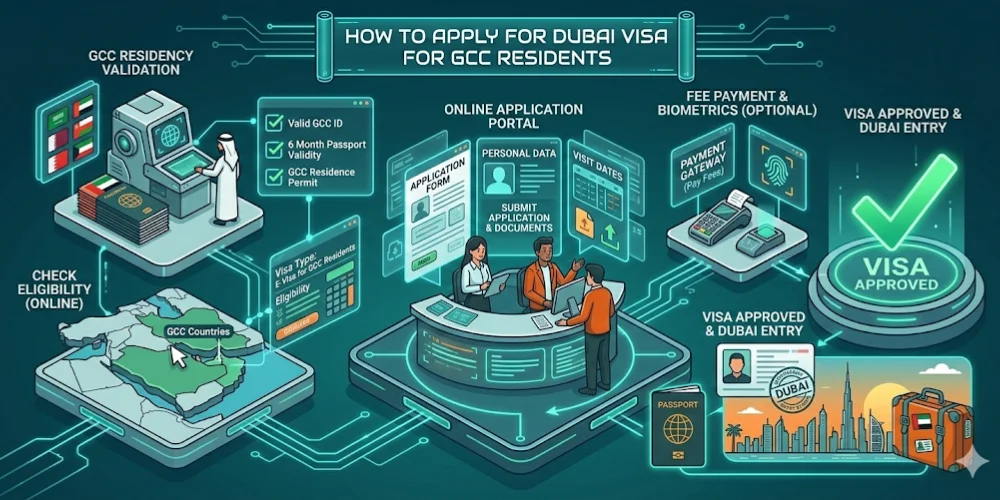
The first step in learning how to apply for Dubai visa for GCC residents is checking your eligibility based on your profession and residency status. To qualify for the GCC resident eVisa, your residency permit in your current country of stay must be valid for at least one year from the date of your arrival in Dubai. Furthermore, your passport must have a minimum validity of six months.
Your profession also plays a significant role in the approval process. While the list of approved professions is broad—covering doctors, engineers, managers, and many other skilled roles—it is subject to evaluation by the General Directorate of Residency and Foreigners Affairs (GDRFA). If your profession on your residency card is listed as a “labor” or “unskilled” category, you may face additional scrutiny or be required to apply for a standard tourist visa instead.
The Step-by-Step Online Application Process
The application for a GCC resident visa is handled entirely online through the official ICP (Federal Authority for Identity, Citizenship, Customs & Port Security) website or the GDRFA portal. You will need to create an account, fill in your personal details, and upload clear scans of your passport and GCC residency card. A digital passport-sized photograph with a white background is also required for the system to process your request.
Once you have submitted the application and paid the required fees—which typically range around AED 250 plus VAT in 2026—the processing time is remarkably fast. Most residents receive their approved eVisa via email within 24 to 48 hours. It is highly recommended to apply at least a few days before your planned travel to account for any weekend or public holiday delays in the UAE.
Read More – How to Apply for Dubai Visa for Schengen Holders
Important Rules Regarding Accompanied Travelers
When considering how to apply for Dubai visa for GCC residents, it is vital to understand the rules for your dependents and sponsored staff. Family members such as your spouse and children can be included in the application, provided they also hold valid GCC residency. Their visas are typically linked to the primary resident’s application and will be processed simultaneously.
If you are traveling with domestic helpers or sponsored staff, they must also have a valid GCC residency permit of at least one year. Crucially, the sponsor (the GCC resident) must be traveling with them or already be present in the UAE for the staff’s visa to be valid for entry. If the staff arrives alone without the sponsor, they may be denied entry at the airport.
Validity, Extensions, and Entry Conditions
The GCC resident eVisa is generally issued for a 30-day stay and is valid for entry into the UAE for 30 days from its date of issue. This gives you a one-month window to plan your trip once the visa is approved. If you find that 30 days in Dubai isn’t enough to finish your business or enjoy your holiday, the visa can be extended once for an additional 30 days.
To extend the visa, you must apply through the same online channels or visit an “Amer” center before your initial 30 days expire. Keep in mind that this is a single-entry visa; if you leave the UAE, the visa is automatically cancelled, and you will need to apply for a new one even if the original 30-day period hasn’t ended. For those who travel frequently, exploring a multiple-entry option might be more beneficial.
Common Mistakes to Avoid During Application
One of the most frequent reasons for visa rejection is a mismatch between the profession listed on the application and the one printed on the GCC residency card. Always ensure that the data you type into the online form is an exact match for your official documents. Even a small spelling error can lead to a delay or an outright rejection of your entry permit.
Another common pitfall is the expiration of the GCC residency permit shortly after arrival. If your residency is set to expire in less than three months, it is safer to renew it in your home country before applying for the Dubai visa. Immigration officers at Dubai airports are strict about the one-year validity rule for residency, and failing to meet this can result in being turned back at the boarding gate.
FAQs on Dubai Visa for GCC Residents
Do I need a physical visa sticker in my passport?
No, the Dubai visa for GCC residents is an eVisa. Once approved, you will receive a PDF document via email. You should carry a printed copy or a digital version on your smartphone to show at the check-in counter and at the Dubai immigration desk upon arrival.
Can I get a visa on arrival if I am a GCC resident?
As of 2026, most GCC residents are required to obtain an eVisa before they travel. While some specific high-level professional categories may still be eligible for on-arrival facilities, the UAE government strongly encourages all residents to use the online system to avoid long wait times and potential entry issues at the airport.
What is the cost of a Dubai visa for GCC residents in 2026?
The standard fee for a GCC resident entry permit is approximately AED 250 to AED 300, which includes the application and issuance fees. Prices may vary slightly depending on whether you apply through the ICP portal, GDRFA, or a third-party travel agency that may charge a service fee.
Is health insurance required for GCC residents visiting Dubai?
Yes, all visitors to the UAE, including GCC residents, must have valid health insurance that covers their stay. In many cases, the insurance is included as part of the visa application fee, but it is always best to double-check and carry a copy of your policy during your trip.
Can I travel to other Emirates with this visa?
Yes, the visa issued for entry into Dubai allows you to travel freely across all seven Emirates of the UAE, including Abu Dhabi, Sharjah, and Ajman. However, your entry and exit points should ideally align with the Emirate that issued your visa to avoid administrative complications.