Table of Contents
ToggleDubai continues to be a magnet for global talent, entrepreneurs, and families seeking a high-quality lifestyle in a tax-free environment. Moving to this vibrant city involves a specific legal process that starts with understanding the right entry permits and ends with receiving your Emirates ID. If you are wondering how to apply for Dubai residency visa in 2026, the process has become more streamlined than ever thanks to digital transformation and new visa categories like the Green and Golden Visas.
Navigating the immigration landscape requires a clear grasp of the different paths available. Whether you are moving for a corporate job, starting your own business, or looking to retire under the Arabian sun, each category has distinct requirements. This guide breaks down the essential steps and documentation you need to secure your future in the United Arab Emirates.
Understanding the Different Paths to Dubai Residency
Before you start the paperwork, you must identify which visa category fits your situation. Most people arrive through company sponsorship, where a local employer handles the bulk of the application. However, recent reforms have introduced self-sponsorship options that offer greater independence for skilled professionals and investors.
The standard employment visa is the most common route. This is issued to individuals who have secured a job offer from a company registered in Dubai or one of its many free zones. In this scenario, the employer acts as your legal sponsor and is responsible for the costs of the visa processing.
Alternatively, the Green Visa is a five-year residency option designed for skilled workers, freelancers, and investors. It does not require a local sponsor or employer, giving you the flexibility to work for yourself or change jobs without needing a new visa immediately. For those with significant capital or exceptional talent, the 10-year Golden Visa remains the gold standard of long-term residency.
How to Apply for Dubai Residency Visa via Employment
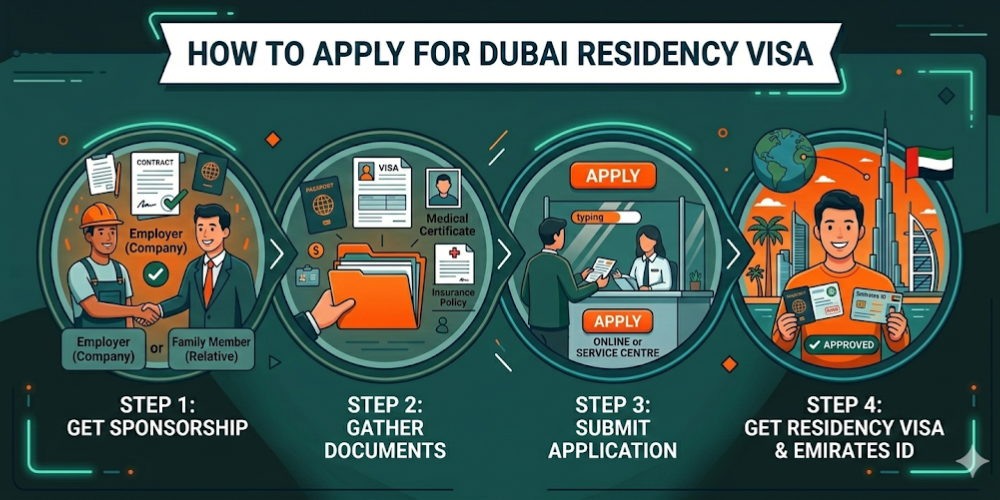
If you have signed a contract with a Dubai-based firm, your journey begins with an entry permit. This document allows you to enter the country legally for the purpose of completing your residency formalities. Your employer will typically request your passport copy and educational certificates, which must be attested by the Ministry of Foreign Affairs in your home country and the UAE Embassy.
Once you land in Dubai with your entry permit, the status change process begins. This officially switches your status from a visitor to a resident. During this period, you should remain within the country to avoid any complications with the processing. Your employer will then schedule your medical fitness test, which is a mandatory requirement for everyone over the age of 18.
The medical test involves a blood test and a chest X-ray to screen for communicable diseases. After passing the medical, you will visit a center to provide your biometrics—fingerprints and a digital photo—for your Emirates ID. This card is your most important document in Dubai, as it is required for everything from opening a bank account to signing a residential lease.
You may like this also – Best Immigration Lawyer Near Me – Top 10 Immigration Lawyers in Dubai, UAE
Securing Residency Through Property Investment
Dubai’s real estate market offers a direct route to residency for those who wish to invest in the city’s growth. In 2026, the rules for the Property Golden Visa have become even more investor-friendly. You can now qualify for a 10-year residency by owning property with a total value of AED 2 million or more, regardless of whether the property is off-plan or mortgaged.
To begin this process, you must provide the title deed issued by the Dubai Land Department. If the property is mortgaged, a letter from the bank stating the paid amount and the remaining balance is necessary. This path is highly popular among expatriates who want to move their families to Dubai permanently without being tied to a specific employer.
Once the investment is verified, the application is submitted through the Dubai Land Department’s “Cube” or the General Directorate of Residency and Foreigners Affairs (GDRFA). Like the employment route, you will still need to undergo a medical checkup and apply for an Emirates ID. The major advantage here is the five-to-ten-year validity, which provides long-term peace of mind.
The Rise of the Green Visa for Freelancers and Professionals
For the modern workforce, the Green Visa represents a significant shift in how to apply for Dubai residency visa. This category is perfect for freelancers and self-employed individuals who can prove an annual income of at least AED 360,000 for the past two years. It eliminates the need for a traditional corporate sponsor, allowing you to be your own boss.
Skilled employees can also apply for the five-year Green Visa if they hold a bachelor’s degree and earn a minimum monthly salary of AED 15,000. This visa is particularly attractive because it allows you to sponsor your family members, including spouse and children, for the same five-year duration.
The application for a Green Visa is done through the ICP (Federal Authority for Identity, Citizenship, Customs & Port Security) website or the GDRFA portal. You will need to upload your employment contract, proof of education, and salary certificates. This DIY approach to residency is part of Dubai’s strategy to attract and retain top-tier global talent.
Essential Documents and Medical Requirements
Regardless of the visa type, certain documents are non-negotiable. You must have a passport with at least six months of validity remaining. You will also need recent passport-sized photographs with a white background that meet specific UAE government standards. If you are sponsoring family members, attested marriage and birth certificates are required to prove your relationship.
The medical fitness test remains a cornerstone of the application. Dubai has numerous medical fitness centers, such as those run by the Dubai Health Authority (DHA). Most results are processed within 24 to 48 hours, though VIP services can provide results in just a few hours.
After the medical results are cleared, the final step is the visa stamping or the issuance of the digital residency permit. In recent years, the UAE has moved away from physical visa stickers in passports, relying instead on the Emirates ID and digital records. Once your Emirates ID is issued, you are officially a resident and can begin the process of sponsoring your dependents.
Sponsoring Your Family Members in Dubai
Once you have secured your own residency, you can act as a sponsor for your family. To do this, you generally need a minimum monthly salary of AED 4,000 or AED 3,000 plus accommodation. You will need to provide your original Emirates ID, your registered tenancy contract (Ejari), and a recent salary certificate or labor contract.
The process for family members mirrors your own: an entry permit is issued, a status change is performed, and they undergo medical testing and biometric collection. It is important to note that sons can be sponsored up to the age of 25, while unmarried daughters can be sponsored indefinitely.
Many residents find that using an “Amer” center simplifies this stage. These are semi-government centers located throughout Dubai that handle all residency-related transactions. They provide a one-stop-shop experience where you can submit documents, pay fees, and track the progress of your family’s applications.
Digital Nomad and Remote Work Visas
If you work for a company outside the UAE but want to live in Dubai, the Virtual Working Program is your best option. This one-year residency permit allows you to enjoy the city’s lifestyle while keeping your international job. As of early 2026, the requirement is a monthly income of at least $3,500.
Applying for this is done entirely online through the Visit Dubai website. You will need to provide proof of employment from your current company or proof of ownership of a company located outside the UAE. You must also show health insurance that covers you within the Emirates.
This visa is an excellent “trial run” for those considering a more permanent move. It gives you a year to experience the local culture, explore neighborhoods, and decide if you want to transition to a more permanent residency like a Green or Golden Visa later on.
Common Challenges and How to Avoid Them
One of the biggest hurdles in the residency process is document attestation. Many applicants face delays because their degrees or marriage certificates are not properly legalized. Always ensure that your documents are attested by the relevant authorities in your home country first, followed by the UAE Embassy in that country, and finally the Ministry of Foreign Affairs (MOFA) in Dubai.
Another common mistake is ignoring the timelines for the status change. Once you enter the country on an entry permit, you have a limited window to complete the residency process. Staying past the validity of your entry permit without starting the residency application can result in daily fines.
Lastly, ensure your health insurance is compliant with Dubai laws. Every resident must have at least the basic Essential Benefits Plan (EBP). If you are a self-sponsored resident or an investor, you are responsible for securing this insurance for yourself and any dependents you sponsor.
Life as a Resident: Next Steps After Approval
Congratulations, you are now a Dubai resident! The first thing you should do is collect your physical Emirates ID. This card is your lifeblood in the city. You will use it to register for DEWA (electricity and water), set up your internet connection, and even get a local driver’s license if your home country’s license is not directly transferable.
You should also download the UAE Pass app. This is the national digital identity for citizens and residents, allowing you to sign documents digitally and access hundreds of government services without needing to visit an office in person. From renewing your car registration to paying traffic fines, the UAE Pass makes life incredibly convenient.
Finally, familiarize yourself with the rules regarding staying outside the UAE. For standard residency visas, staying outside the country for more than six months can result in the visa becoming invalid. However, Golden Visa holders are exempt from this rule, allowing them to travel freely for extended periods without risking their residency status.
FAQs
What is the minimum salary to sponsor a family in Dubai?
To sponsor your spouse and children, you generally need a minimum salary of AED 4,000 per month or AED 3,000 if your employer provides accommodation. You must also provide a valid tenancy contract and attested relationship documents.
How long does it take to get a Dubai residency visa?
The entire process usually takes between 10 to 21 days. This includes obtaining the entry permit, completing the medical test, and submitting biometrics for the Emirates ID. Using express services can reduce this time to about a week.
Can I apply for a Dubai residency visa while on a tourist visa?
Yes, you can apply for residency while inside the country on a tourist visa. You will need to undergo a “status change” process, which allows you to switch from a tourist to a resident without having to exit and re-enter the country.
Do I need a job to stay in Dubai?
Not necessarily. While employment is the most common path, you can also stay in Dubai through an Investor Visa, a Green Visa for freelancers, a Retirement Visa, or by being sponsored by a family member who is already a resident.
What happens if my residency visa is cancelled?
If your visa is cancelled, you are typically granted a grace period to either leave the country or secure a new visa. As of 2026, these grace periods have been extended for many visa types, often ranging from 30 to 180 days depending on the category.